Grand Challenges In SportsHCI
Jan 8, 2026
The paper argues that Sports Human-Computer Interaction has matured beyond isolated, sport-specific systems but lacks a coherent, long-term research agenda. To address this, the authors synthesize insights from a five-day international expert seminar and articulate a set of grand challenges to guide the field over the next decade.
| Challenge | Description | Sub-challenges |
|---|---|---|
| Challenge 1 | Lack of knowledge how interactive technology can support performance optimization | • Lack of knowledge how to design real-time bodily performance analysis systems for coach and athlete feedback and sense-making • Lack of knowledge in designing interactive technologies for the longitudinal nature of athletic performance • Lack of knowledge how to integrate biomechanics into SportsHCI methods • Lack of knowledge how to utilise real-time sensemaking of bodily performance analysis in novel digital-physical exercises |
| Challenge 2 | Lack of understanding how to design interactive technologies for various parties involved in sports engagement | • Lack of understanding how to support the coach–athlete relationship using interactive technology • Lack of understanding how to support the intricate relationship between athletes and spectators using interactive technology • Lack of understanding how to design for athlete-oriented challenges |
| Challenge 3 | Lack of knowledge how to design interactive technologies for the athlete being a multifaceted individual | • Lack of knowledge how to model the athlete to design interactive technologies • Lack of knowledge how to develop interaction technologies to support the athlete beyond bodily performance advice • Lack of knowledge how to take into consideration individual non-athletic performance facets when designing SportsHCI technologies |
| Challenge 4 | Lack of knowledge how to take SportsHCI research and design into the real sporting world | • Lack of knowledge how to validate SportsHCI technology in complex and dynamic real-world sporting environments • Lack of understanding how to design interactive technology to support the experiential side of sports in daily life • Lack of understanding how to design interactions to deal with multifaceted, enormous sports data |
| Challenge 5 | Lack of a long-term vision on how SportsHCI should be designed for social impact | • Lack of understanding how to address the pandemic of physical inactivity through SportsHCI • Lack of evaluation criteria for whether a SportsHCI intervention improves physical literacy • Lack of understanding how to overcome barriers to sports access |
Challenge 1: Lack of knowledge of how interactive technology can support performance optimization
Lack of knowledge of how to design real-time bodily performance analysis systems.
Identify:
- effective content
- best modality to provide feedback
- when to deliver the feedback
"capturing more fne-grained data at a faster pace (than a human coach) and then delivering feedback across multiple modalities in quick successive repetition."
Lack of knowledge in designing interactive technologies for the longitudinal nature of athletic performance.
"understanding SportsHCI in a longitudinal setting is essential to generalising the impact of interactive technologies in athlete performance optimisation in the long run and understanding the life cycle of performance optimisation."
"If a technology uses novel sensing and feedback, confrming that the sensing and actuation response remains the same over time is important."
- Testing the vision on the same image multiple times
It's hard because a PhD Thesis doesn't have so much time to do such as long-term study.
Lack of knowledge on how to integrate biomechanics into sportsHCI.
Lack of knowledge on how to utilise real-time sensemaking of bodily performance analysis in novel digital-physical exercises.
Data visualization, LLM Response on-click instead of everytime.
"SportsHCI systems typically do not remotely leverage the full power of advanced data processing. Usually, these systems focus on innovative interaction technology but use only quite basic forms of sensor measurements and data processing compared to the state of the art."
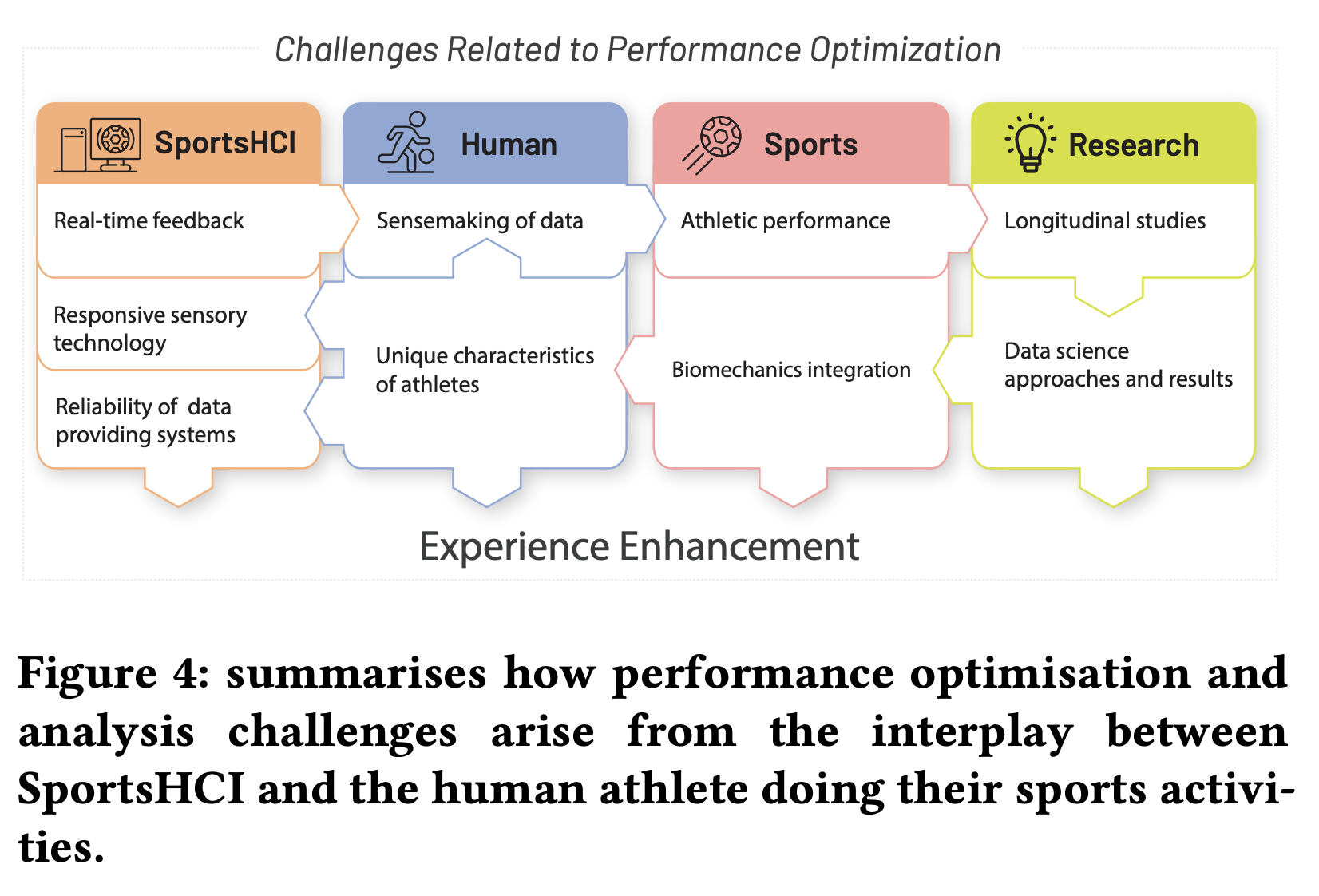
Challenge 2: Lack of understanding of how to design interactive technologies for various parties involved in Sports Engagement
"movement” as a core creative resource (that's a freaking cult?)
Lack of understanding of how to support the coach-athlete relationship using interactive
Coach's input directly into LLM
Lack of understanding of how to support the intricate relationship between athletes and spectators using interactive technology
Lack of understanding of how to design for the athlete-oriented challenges
"creating personalised solutions for individual athletes remains a signifcant challenge due to the many intricate factors that impact an athlete’s performance"
addressing athlete's motivation, handling failures
Challenge 3: The athlete as a multifaceted individual
Lack of models that capture athletes’ physical, emotional, cognitive, and social dimensions.
Overemphasis on bodily performance metrics at the expense of emotional support and mental well-being.
Poor consideration of non-sport life factors, such as values, long-term goals, identity, and enjoyment.
Challenge 4: Moving SportsHCI into the real world
Challenges validating systems in dynamic, uncontrolled sports environments.
Tension between technological intervention and the experiential qualities of sport, such as immersion, wilderness, and qualitative experience.
Difficulty designing interaction with massive, heterogeneous, longitudinal sports data across devices and life contexts.
Challenge 5: No clear SportsHCI strategy for addressing physical inactivity at population scale.
Lack of evaluation frameworks linking SportsHCI interventions to physical literacy and motor competence.
Persistent barriers to sports access related to gender, disability, socioeconomic status, and inclusion.